
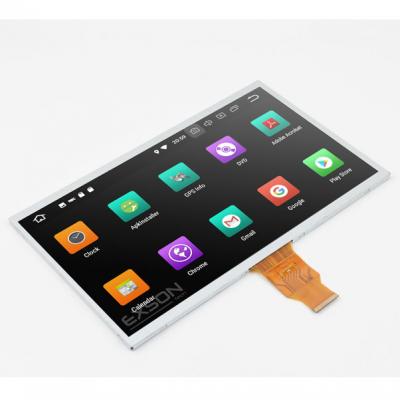
Resistive LCD is an inductive liquid crystal display device capable of receiving input signals from contacts and other inputs. The resistive LCD locates the touch point through the pressure difference between two layers of conductive materials (such as ITO coatings). These two layers of materials are respectively coated on the opposite surfaces of a film and glass. When a touch operation occurs, the ITO under the film can contact the ITO coating on the glass layer, resulting in a change in resistance, which then triggers signal transmission and processing.
Simple structure, lower cost
Can be activated by any object that applies pressure due to its pressure-applying function
Resistant to water/dirt
Lower power consumption
Different input methods
Resistive LCD supports multiple methods such as fingers, styluses, or other objects that apply pressure, while capacitive LCD display only supports body touch.
Different surface materials and durability
Resistive LCD is film+glass, capacitive is glass+glass/glass+film; surface hardness differs, resistive is easily damaged when cracked, while capacitive can still work with small cracks.
Different anti-interference abilities
Capacitive LCD display is more sensitive and thus has poorer anti-interference abilities.
Touch detection
When a user touches the screen with a finger or other object, the two layers of conductive materials contact at the touch point, causing a change in resistance at that point.
Signal transmission
The change in resistance is detected by sensors and converted into electrical signals, which are then transmitted to the processor via conversion circuits.
Position calculation
The processor receives the signals and performs computations to determine the exact location of the touch point (X, Y coordinates).
Interface response
Based on the location information of the touch point, the system drives the corresponding connected devices or software interfaces to complete the user's operational instructions.
 Finding the Perfect LCD Display Module for Sale: A Comprehensive GuideOctober 23, 2023LCD display modules have become indispensable in various industries and applications, from consumer electronics to industrial equipment. Their versatility and clarity make them an excellent choice for...view
 The Difference Between LCD and LEDSeptember 26, 2022Customers often ask us about the difference between LCD and LED. Seen below will explain it in detail for you.1. Brightness: the response speed of a single element of the LED display is 1000 times tha...view
 The Importance of Clean Rooms in the Production Process of Industrial LCD ScreensAugust 4, 2023We will discuss the importance of clean rooms in the production process of industrial LCD screens. Let's start with the definition.A clean room is not simply defined as a clean space. In fact, it ...view
 Integrating Industrial TFT Display with Embedded SystemsMay 9, 2024With the development trend of industrial automation and intelligence, the integration of industrial TFT display and embedded system has become the key to improve the efficiency of human-computer inter...view
 Exploring the Different Types and Remarkable Features of Touch Panel ModulesJanuary 25, 2024In today's tech-savvy world, touch screen technology has become an integral part of our daily lives. From smartphones and tablets to smart appliances, touch panel modules enhance the user experien...view
 Introduction of the Applications of Medical LCD Display ScreenAugust 4, 2023In the hospital, we often see medical equipment, and most of the medical equipment is equipped with medical LCD display screens. So, do you know what the uses of LCD display screens in medical field a...view
 Call us on:
  Email Us:
  2F-M1 XiaWei Industrial Park, GuanLan, LongHua District, SZ, China
  www
www


